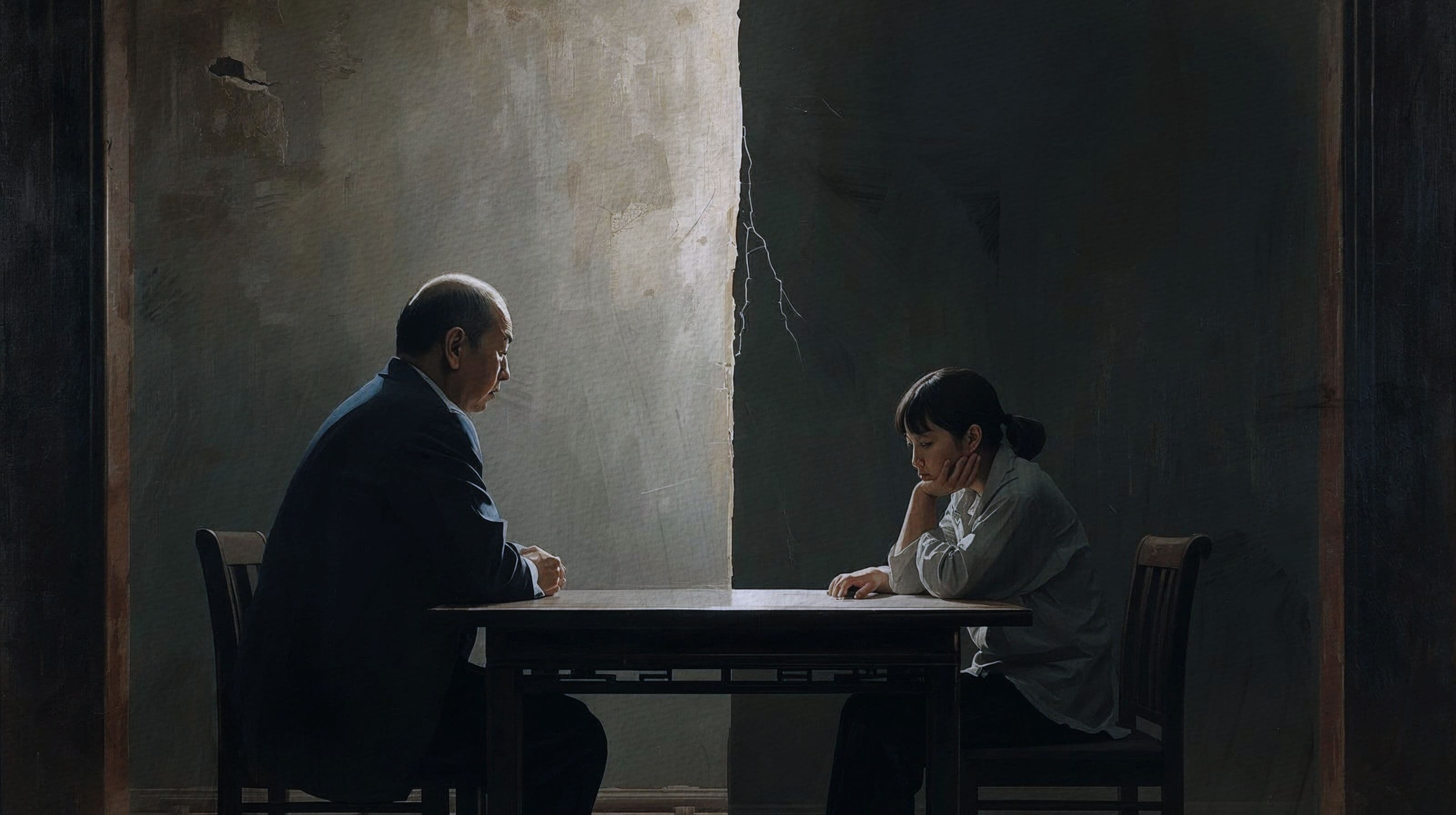

Filial piety, meaning, the idea of respect, obedience to — not actually true, we’ll get to that later — and care for parents and elders, is a value most commonly associated with Asian family structures. This is usually noted in contrast with Western families where individual experience often triumphs the needs of family or parental desires. Whilst noble on the surface, and often admired by outsiders (especially non-Asians who often conflate this with warm and fuzzy familial relations), filial piety actually hides subtle tyranny under the cover of “social harmony”, “respect”, “obedience” and “face”.
To understand the root of this dysfunction, we must first understand where the idea of filial piety came from. If you asked most Asian parents (the ones who constantly demand it), they wouldn’t be able to answer you. Instead of understanding the root text behind filial piety, they instead cite cultural scripts which demand obedience. Some examples of what they might say are:
- “Good Asian kids listen to their parents”
- “I’m your parent, you should listen to me”
- “I put food on the table and give you shelter, so you must listen to me”
Clearly, none of these are valid logical explanations for the origins of filial piety, but rather convenient beliefs almost all of Asian culture has unconsciously adopted to prop up the fragile egos of Asian parents who cannot self-reflect or think for themselves.
The truth is that filial piety has its roots in Confucian thought. That is, a philosophical, ethical and social governance framework created by a guy called Confucius (note: this is the Latinised version of his Chinese name, 孔子, which means “Master Kong”. His real name was 孔丘, or “Kong Qiu”).
Confucius lived during the Spring and Autumn period in Chinese history (roughly 770–476 BCE). This was a period marred by political dysfunction, corruption, collapsing social order and frequent war between small states. His goal wasn’t to create a family management system, but to provide a philosophy and framework for organizing and managing the state to create stable governance through the cultivation of morality, thus restoring order to a chaotic world.
The question he tried to answer with his framework was: “How do you produce a harmonious society when rulers are incompetent and institutions are decaying?”
His conclusion was:
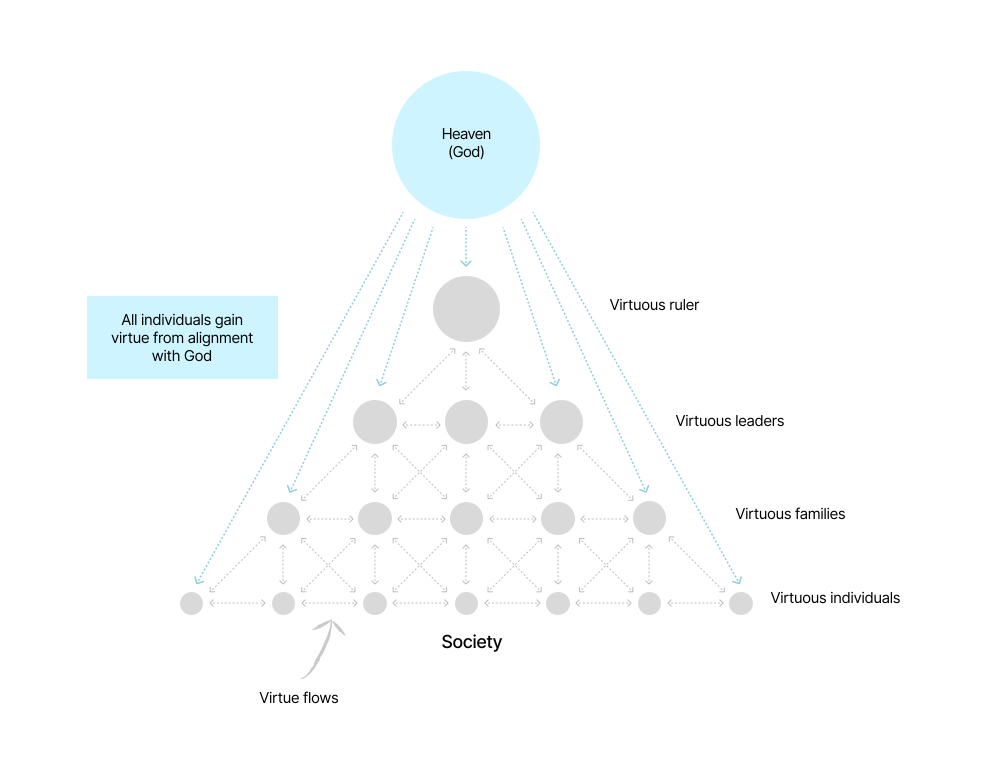
- You develop virtuous individuals
- Virtuous individuals create virtuous families
- Virtuous families lead to virtuous leaders
- Society becomes robust when virtue pervades at every level
Thus, Confucius started bottom-up, with the individual first, not top-down from the state or authority figures. The idea was, if we can instill virtue and morality in the individual parts, then the whole will be virtuous and moral too.
The five levels of Confucian structure
There are 5 levels to the structure of Confucianism.
- Level 1 — Ren (仁): Humaneness — Development of a moral heart, compassion, empathy and moral discernment.
- Level 2 — Li (禮): Proper conduct — This is the true embodiment of morality and virtue, leading to conducting oneself in a proper manner.
- Level 3 — Xiao (孝): Filial piety — Contrary to modern use in Asian social dynamics, it does not mean blind obedience, but reciprocal virtue, respect and compassion within a family. Parents and children mutually embody respectful, compassionate conduct with each other. It’s meant as a circular relationship of virtue.
- Level 4 — Junzi (君子): The noble person — This is the well-developed, morally upright person who acts as a stabiliser within society. Confucius wanted to replace aristocracy and rule by birth, with aristocracy by character.
- Level 5 — State harmony: When rulers are chosen by their character and virtue, not by birth or inheritance, the people imitate and reflect the same character. When rulers are corrupt, society decays.
As you can see, Confucianism begins in the heart of the individual and expands outward: first as virtuous behaviour in the person, then as virtuous relationships between individuals, and finally as the elevation of such individuals into roles of authority so they can guide others toward morality and virtue.
You can think about it like a typical pyramidal hierarchy, but instead of rulers and leaders being granted authority due to inheritance, corruption or favour, they are only given authority by meeting strict criteria for virtuous and moral behaviour. The key idea here is that only individuals who embody true alignment with the moral principles given by Heaven are granted authority. Thus, rulers, leaders and parents in such a system embody qualities such as respect, compassion, guidance toward virtue, ego-lessness and subservience to Heaven (not tradition).
How Confucianism was distorted
Confucianism, which was meant to place virtue first and let hierarchy arise only as a consequence of virtue, has been distorted into a culture that worships hierarchy and structure for their own sake, completely detached from virtue. In the modern Asian family structure, this is mindlessly swallowed up as:
- Children should always listen to and obey parents (even if parents are wrong, or acting immorally)
- Parents have unquestioned authority over the lives of children and are entitled to meddle where they see fit
- “Stability” of the family trumps adherence to virtue. “Give face” to others to avoid rocking the boat. Don’t speak truth. Don’t stand up for righteousness, just keep quiet to avoid “disrespect”
Confucius would be rolling in his grave if he saw how his teachings were perverted to accommodate the insecure egos of Asian parents and the blatant disrespect directed towards their children.
His system was always centered on virtue as the key ingredient that leads to everything else. Virtue is granted by an individual aligning with Heaven (divine will) and transmitting that virtue through the rest of society to create a virtuous society. Sounds beautiful doesn’t it? Because it is. Unfortunately, the modern toxic dynamics in many Asian family structures don’t reflect the virtuous beauty Confucius intended with his ideas.
Of course, it’s unsurprising that beautiful ideas rooted in absolute truth become, at some point, hijacked by ego. Truth almost never survives institutionalization and this is most prominently seen in the distortions of mainstream religion and many well-meaning social causes.
The root of this rot is a spiritually asleep society. Confucius taught that every individual has the duty to cultivate virtue by first aligning with Heaven. All behaviour and character must therefore be measured against divine truth. This standard was meant to apply equally—from the lowest servant to the Emperor himself. No one was entitled to preferential treatment, only character determined a person’s standing, as all are equal before Heaven.
This is made explicit in the Analects 13.15 where Confucius is recorded as saying, “If the ruler has faults, admonish him,” and in 4.18, “In serving your parents, remonstrate gently. If you see they are determined not to follow your advice, remain respectful yet firm.”
“In serving your parents, remonstrate gently. If you see they are determined not to follow your advice, remain respectful yet firm.” — Analects 4.18
It’s clear then: modern Asian filial norms are not Confucian at all — they are a corruption wearing Confucius’ name like a mask. The Analects teach that rulers must be admonished and parents must be resisted when they are wrong, yet Asian parents demand unconditional obedience, moral silence and emotional subservience. This is not philosophy. It is ego, fear and inherited dysfunction masquerading as tradition. Confucius never sanctified authority, he sanctified virtue. The fact that modern Asian families confuse the two only shows how far they have drifted from the very teachings they claim to uphold.
“To remonstrate with one’s parents is to serve them with utmost loyalty.” — Zhu Xi
Parents are not entitled to control a child’s destiny
Confucius also made it clear that parents are not entitled to dictate the moral destiny of their children. In his view, each person receives their ming (命) — their Heaven-given mandate (destiny) — as an individual, not as an extension of their parents’ unresolved ambitions or fears.
Mencius explicitly states in Mencius 7A:1, “A person receives their mandate (ming) from Heaven, parents and rulers cannot alter it.”
Likewise, the Book of Rites emphasises that, “The great duty of a parent is to nurture what Heaven has endowed, not to command the child’s path.”
“A person receives their mandate from Heaven, parents and rulers cannot alter it.” — Mencius 7A:1
In other words, a parent’s role is stewardship, not ownership. To force a child into a predetermined life script is not Confucian, it is a violation of Heaven’s authority. Confucius saw each person’s alignment with Heaven as sacred, and any attempt by parents to override that alignment was, in effect, an attempt to play God.
Thus, the modern Asian norm of projecting parental desires onto the child has no basis in Confucian teaching and directly contradicts the philosophical framework it claims to descend from.
Parents must treat children with virtue and respect
Confucian texts are also unambiguous that parents themselves must act with virtue toward their children. Filial piety was never a one-way obligation but a reciprocal moral relationship, grounded in mutual respect and upright conduct.
Confucius makes this explicit in the Analects 2.3: “Lead them with virtue, guide them with propriety. In this way the father is at peace and the son respectful.”
The Book of Rites reinforces the same principle, stating that, “Affection and respect must flow in both directions, only then is the family upright.”
These teachings leave no room for the modern Asian belief that parents possess automatic moral license simply by virtue of being parents. Confucius never endorsed entitlement, boundary-breaking, or emotional coercion disguised as “family harmony.” In his framework, parents were required to embody virtue first, only then could they expect moral conduct from their children. A parent who behaves without virtue forfeits the moral ground on which true filial piety rests, because respect cannot be coherently demanded by someone unwilling to offer it.
“Affection and respect must flow in both directions, only then is the family upright.” — Liji, Qu Li
Where modern Asian family structure diverges
If all individuals are to align with virtue and morality (as Confucius said), then virtue should be the fundamental principle of the relationship between parent and child. If the parent acts immorally, the child is expected to respectfully protest and persist in one’s effort to correct their parents.
There is absolutely no mention of blind obedience to parents. This misconception is due to mistranslations and dynastic authority who decided to endorse Confucianism as their official governance framework. As we know, whenever imperial authority endorses a religious or philosophical framework, it usually never ends well, truth inevitably is stripped out and ideas are bent toward whatever suits the interests of the imperial system.
Thus, the default assumptions that we accept as normal or, God help us, “good” (in the eyes of most Asian parents) are actually completely contradictory to the original teachings of Confucius.
- He would never advocate for blind obedience to parents. This is an Asian cultural myth, passed down through generations who never understood how the myth came to be.
- He would never endorse parental entitlement to their children's lives. Confucius believed each person has a moral destiny (命) tied to Heaven. To commandeer a child’s life path is to sever their relationship with that destiny.
- He would never elevate family hierarchy above moral righteousness. The entire Confucian system rests on yi (義), righteousness. If a parent’s command violates righteousness, the child’s duty is to protest respectfully, not comply.
- He would never see silence in the face of wrongdoing as filial piety. True filial piety required moral courage. A child who remains silent when parents act unjustly is failing in their duty, not fulfilling it.
- He would never say parents are beyond moral correction. Confucius explicitly taught that children must correct their parents’ faults respectfully but persistently. Moral immunity for parents is a modern fabrication.
- He would never conflate obedience with respect. Respect is about conduct, tone and sincerity, obedience is a behavioural outcome that should only ever occur if the request was virtuous. The two are not the same, and Confucius never collapsed them.
Conclusion
If we were to get back to the original teachings of Confucius, it’s obvious that the current state of Asian family structures would inevitably collapse. Children would no longer feel suffocated in the face of their parents’ ego tantrums and dysfunction. Parents would be expected to lead from a place of virtue and truth, not simply on the grounds that their child was the product of their DNA. Mere provision of shelter, food and clothing would be insufficient criterion for determining the success of a parent, but would actually require introspection and assessment of one’s own character and whether it aligns with what is truly virtuous.
Obviously, returning to such an ideal is unlikely. Dissolving thousands of years of cultural scripts, and getting Asian parents to challenge their own ego-structures is wishful thinking at best. All we can hope for is that individuals stop outsourcing morality to tradition and start thinking again.
If modern Asian families collapse under the weight of true Confucian virtue, then let them collapse — they were never built on virtue to begin with. Confucius would not mourn the downfall of dysfunctional households. He would welcome the emergence of people who live in alignment with Heaven and virtue instead of cultural scripts. He never meant family as a replacement for virtue, but virtue as a necessity for strong families.
Asian culture has inverted this to the point of blind worship of family as some sort of perfect, aspirational ideal. However, its clear to me that a family without virtue is no family at all. As Jesus said in Luke 14:26: “If anyone comes to me and does not hate his father and mother, wife and children, brothers and sisters — he cannot be my disciple”.
Of course, Jesus didn’t mean to literally “hate”. The word “hate” in the Semitic and Greek context meant “to place second”, meaning to prioritize less. So, in the end, individuals must choose virtue above family, if family comes in conflict with virtue. For virtue is divine, and what is divine trumps all else, especially false structures that fail to uphold true virtue.